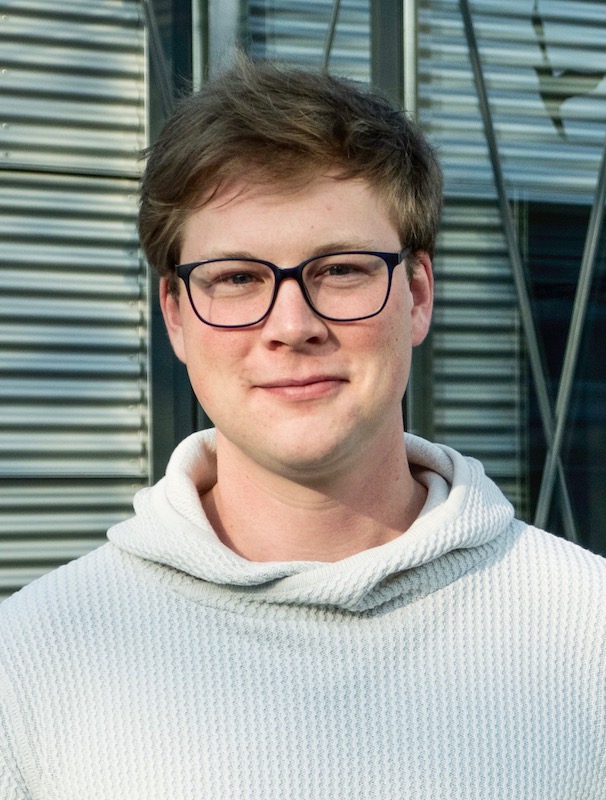
New group-lead at the University of Zurich in numerical relativity, computational astrophysics, and high-performance computing. Developing the next generation of massively parallel simulations of black holes and gravitational waves.

Research

Numerical relativity simulations of black holes and gravitational waves

My group develops the next generation of numerical relativity simulations of merging black holes and their gravitational waves. We solve Einstein’s equations of general relativity on large supercomputers, combining high-order discontinuous Galerkin methods with massive parallelism. With these simulations we study the dynamics of black hole binaries through their inspiral, merger, and ringdown regimes, and we predict the gravitational wave signals observed by detectors such as LIGO and Virgo. This work is essential to power the next generation of gravitational wave observatories, foremost the upcoming LISA space mission and the Einstein Telescope.

Students:

  • Iago B. Mendes (Caltech)
  • Himanshu Chaudhary (Caltech)

Former students:

  • Hannah Röttgen (Caltech / DAAD)

Selected publications:

GPU-acceleration of numerical relativity

We develop GPU-accelerated numerical relativity simulations to break the current computational limitations of binary black hole simulations at high mass ratios and high spins, in particular at the accuracy required for the next generation of gravitational wave detectors.

Black hole mergers at high mass ratios

We develop methods to simulate binary black hole mergers at high mass ratios (q > 10), which are important sources of gravitational waves for the upcoming LISA space mission. We also connect these simulations to perturbation theory in the mass ratio (gravitational self-force theory).

Light rings in dynamical spacetimes

We study the properties of light rings in dynamical spacetimes, which are important for understanding the emission of gravitational radiation during black hole mergers. We develop methods to track light rings in numerical relativity simulations through the violent dynamics of the merger, and we study their connection to the gravitational wave emission. (Image credit: Isabella Pretto)

Students:

  • Isabella Pretto (Caltech)

ML-acceleration of numerical relativity

We are developing machine learning methods to accelerate numerical relativity simulations. We learn from existing simulations to predict the dynamics of black hole binaries and to accelerate new simulations without compromising their accuracy.

Students:

  • Vittoria Tommasini (Caltech)

Selected publications:

  • Tommasini, Vu, Scheel, and Teukolsky (2026). Data-Driven Acceleration of Eccentricity Reduction for Binary Black Hole Simulations. Submitted to Phys. Rev. D. arXiv:2604.22021.

Gravitational self-force calculations with numerical relativity methods

My group develops a new method to simulate extreme mass-ratio inspirals (EMRIs), in which a stellar-mass object spirals into a supermassive black hole. These systems are among the key gravitational wave sources for the upcoming LISA space mission, but very challenging to simulate. We apply numerical-relativity methods to solve the gravitational self-force problem, solving the Einstein equations expanded perturbatively in the small mass ratio.

Students:

  • Nami Nishimura (AEI Potsdam)
  • Cillian Kelly (U Southampton)

Selected publications:

  • Vu et al. (2026). Self-force calculations with numerical relativity methods. Submitted to Phys. Rev. D. arXiv:2606.04998.

Recent publications

Habib et al. +Vu (2026). Error quantification and comparison of binary neutron star gravitational waveforms from numerical relativity codes. Submitted to Phys. Rev. D. Phys. Rev. D 113, 10, p. 104062. arXiv:2509.23028.

Khairnar et al. +Vu (2026). Fixing the center-of-mass frame of numerical relativity waveforms using the post-Newtonian center-of-mass charge. Submitted to Phys. Rev. D. arXiv:2603.24661.

Tommasini, Vu, Scheel, and Teukolsky (2026). Data-Driven Acceleration of Eccentricity Reduction for Binary Black Hole Simulations. Submitted to Phys. Rev. D. arXiv:2604.22021.

Wu et al. +Vu (2026). Eccentricity as a signature of hierarchical subsolar-mass mergers in collapsar disks. Submitted to ApJL. arXiv:2604.26912.

Ravichandran et al. +Vu (2026). Merger remnant and eccentricity dynamics surrogates for eccentric nonspinning black hole binaries. Submitted to Phys. Rev. D. arXiv:2605.00124.

Vu et al. (2026). Self-force calculations with numerical relativity methods. Submitted to Phys. Rev. D. arXiv:2606.04998.

Wittek et al. +Vu (2025). Relieving Scale Disparity in Binary Black Hole Simulations. Phys. Rev. Lett. 134, 25, p. 251402. arXiv:2410.22290.

Zhu et al. +Vu (2025). Black Hole Spectroscopy for Precessing Binary Black Hole Coalescences. Phys. Rev. D 111, 6, p. 064052. arXiv:2312.08588.

Ma et al. +Vu (2025). Einstein-Klein-Gordon system via Cauchy-characteristic evolution: Computation of memory and ringdown tail. Class. Quant. Grav. 42, 5, p. 055006. arXiv:2409.06141.

Lovelace et al. +Vu (2025). Simulating binary black hole mergers using discontinuous Galerkin methods. Class. Quant. Grav. 42, 3, p. 035001. arXiv:2410.00265.

Nee, Lara, Pfeiffer, and Vu (2025). Quasistationary hair for binary black hole initial data in scalar Gauss-Bonnet gravity. Phys. Rev. D 111, 2, p. 024061. arXiv:2406.08410.

Recent side projects

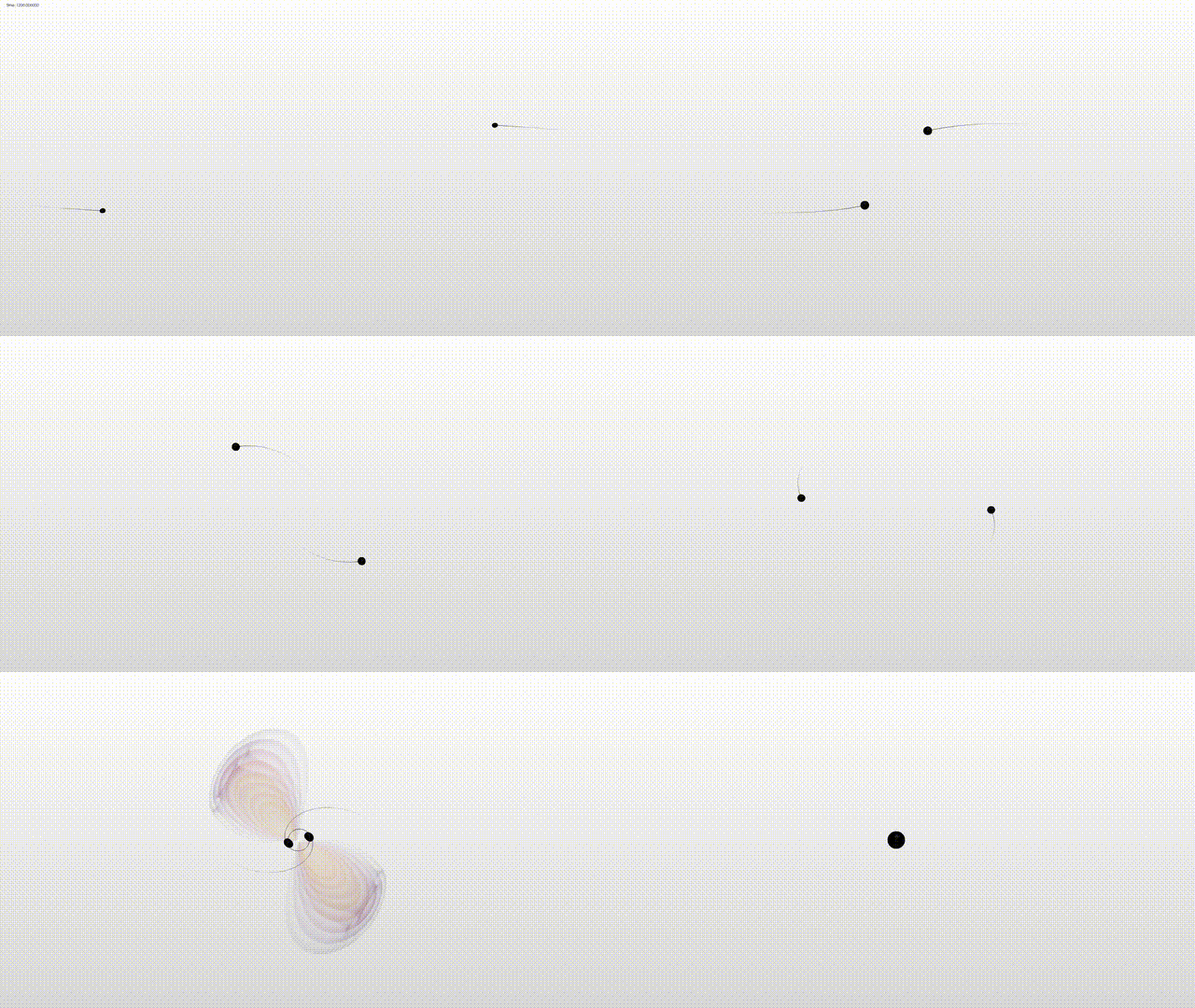
Visualization of a black hole scattering and capture event

A visualization I created in 2024.

Rendering of a simulation with two black holes that scatter and then merge, emitting gravitational waves.

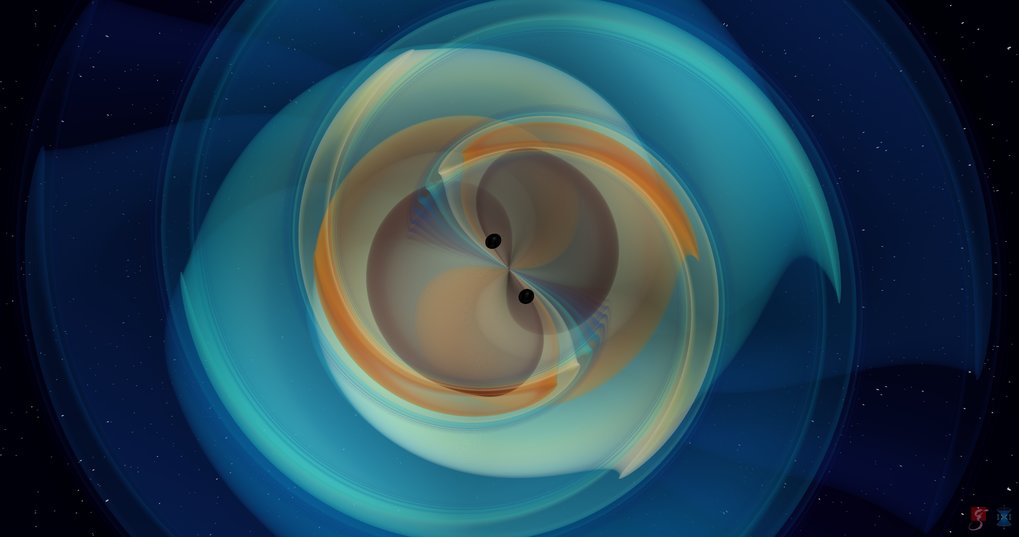
Visualization of GW190521

A visualization I created in 2020.

Renderings of the particulary high-mass gravitational-wave event measured by LIGO and Virgo on May 21, 2019.

Visualization of GW190814

A visualization I created in 2020.

Renderings of the highly unequal-mass gravitational-wave event measured by LIGO and Virgo on Aug 14, 2019.

Visualization of GW190412

A visualization I created in 2020.

Widely publicized renderings of the first unequal-mass and precessing gravitational-wave event measured by LIGO and Virgo on Apr 12, 2019.